
TLC Wizard
Advantages
- Excellent cleanability – simple shape, durable materials
- Glass working surface – wet strips can be measured directly
- Printout of the required records
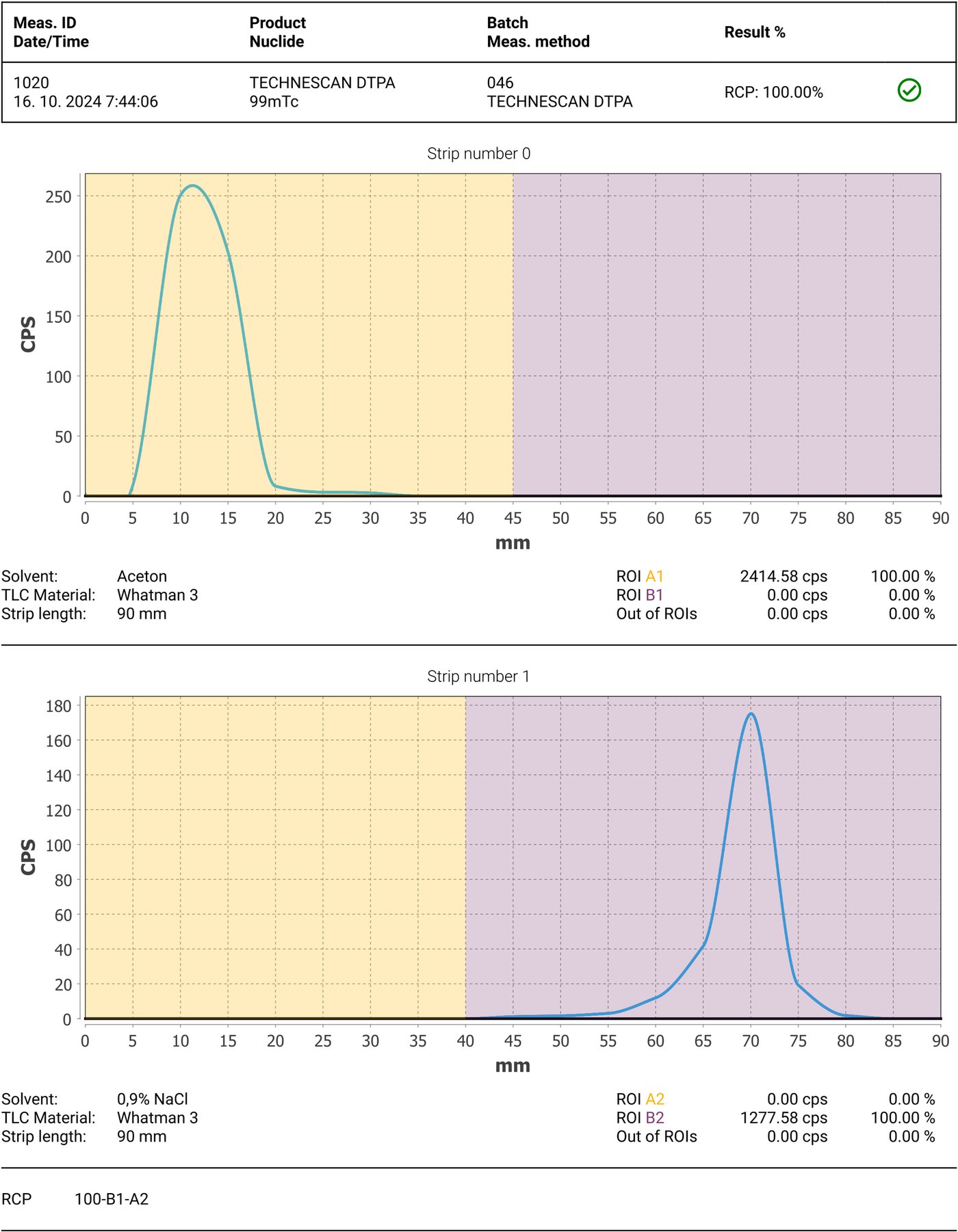
- Results displayed as a graph with the percentage distribution of activity in the ROI
- Easy, intuitive operation via PC
- Database of products, nuclides, solvents, etc.
- Presets for easy repeated measurements
- Printing of results stored in memory
- Built-in check source for automatic daily QC
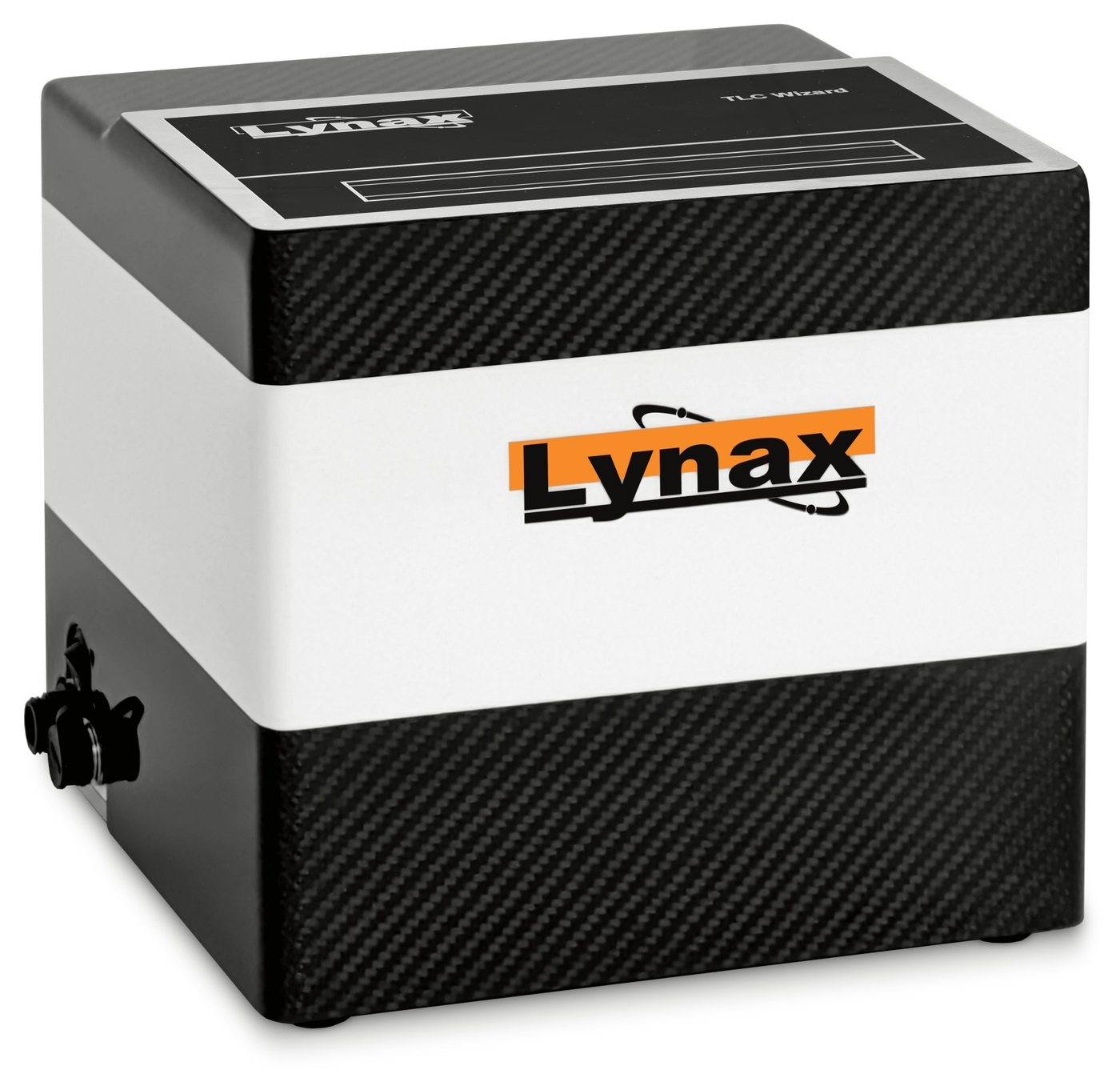
- Compact design 230 × 230 × 215 mm
Purpose and use
The device provides easy and accurate measurement of the relative activity distribution along the length of a chromatography strip. The result is displayed simultaneously as a percentage in the regions of interest (ROI) and as a graph. Automatic background detection (with the option of manual adjustment) ensures that the results are not falsely negative.
The measurement procedure and calculation formula can be pre-defined for each kit according to the product manufacturer’s requirements. The software supports custom settings using the multiple-strip method and calculation of multiple ROIs. The entire measurement procedure can be saved as a preset for daily routine measurements.
The measured length is up to 200 mm (150 mm in the standard version).
Design
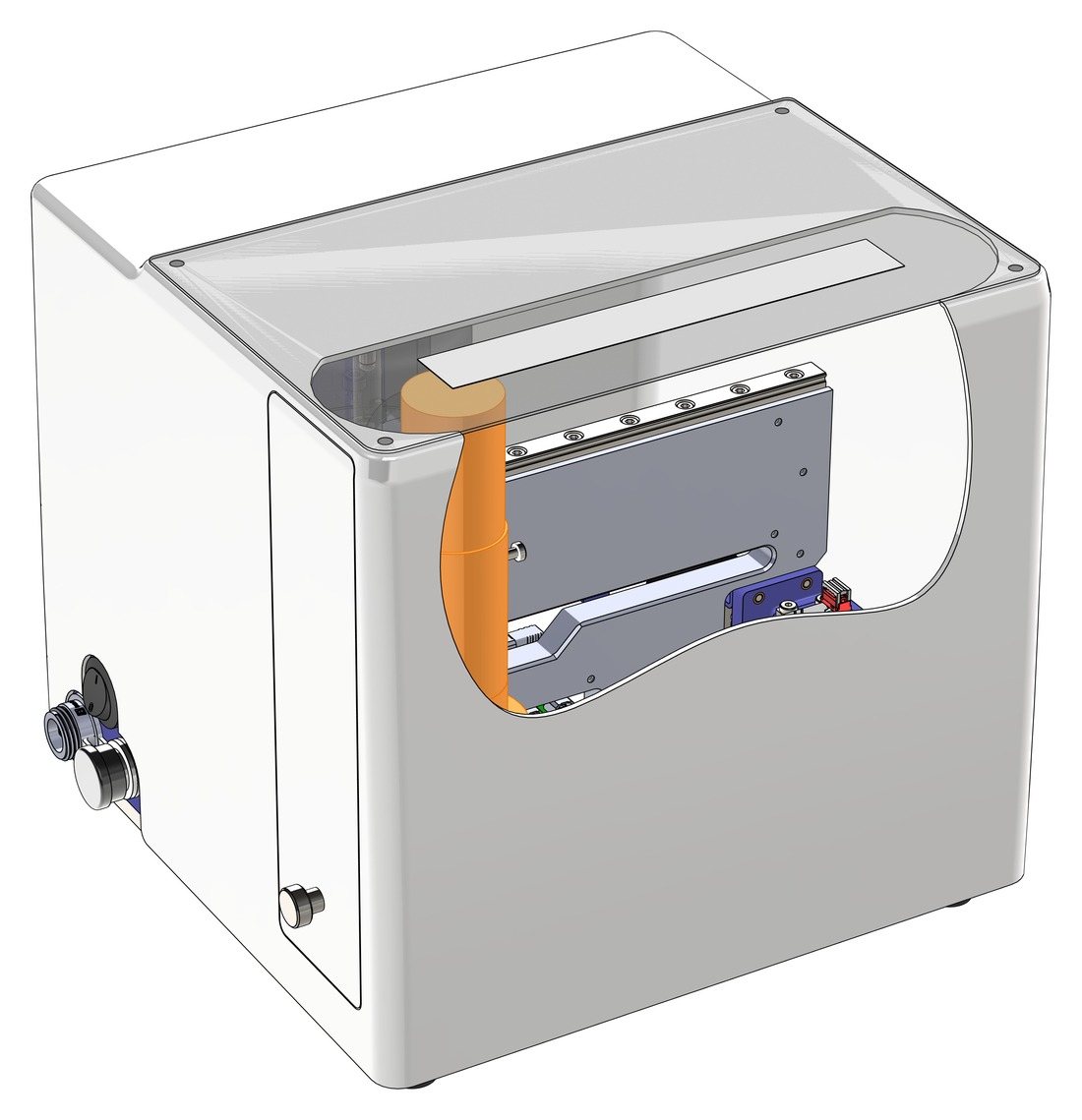
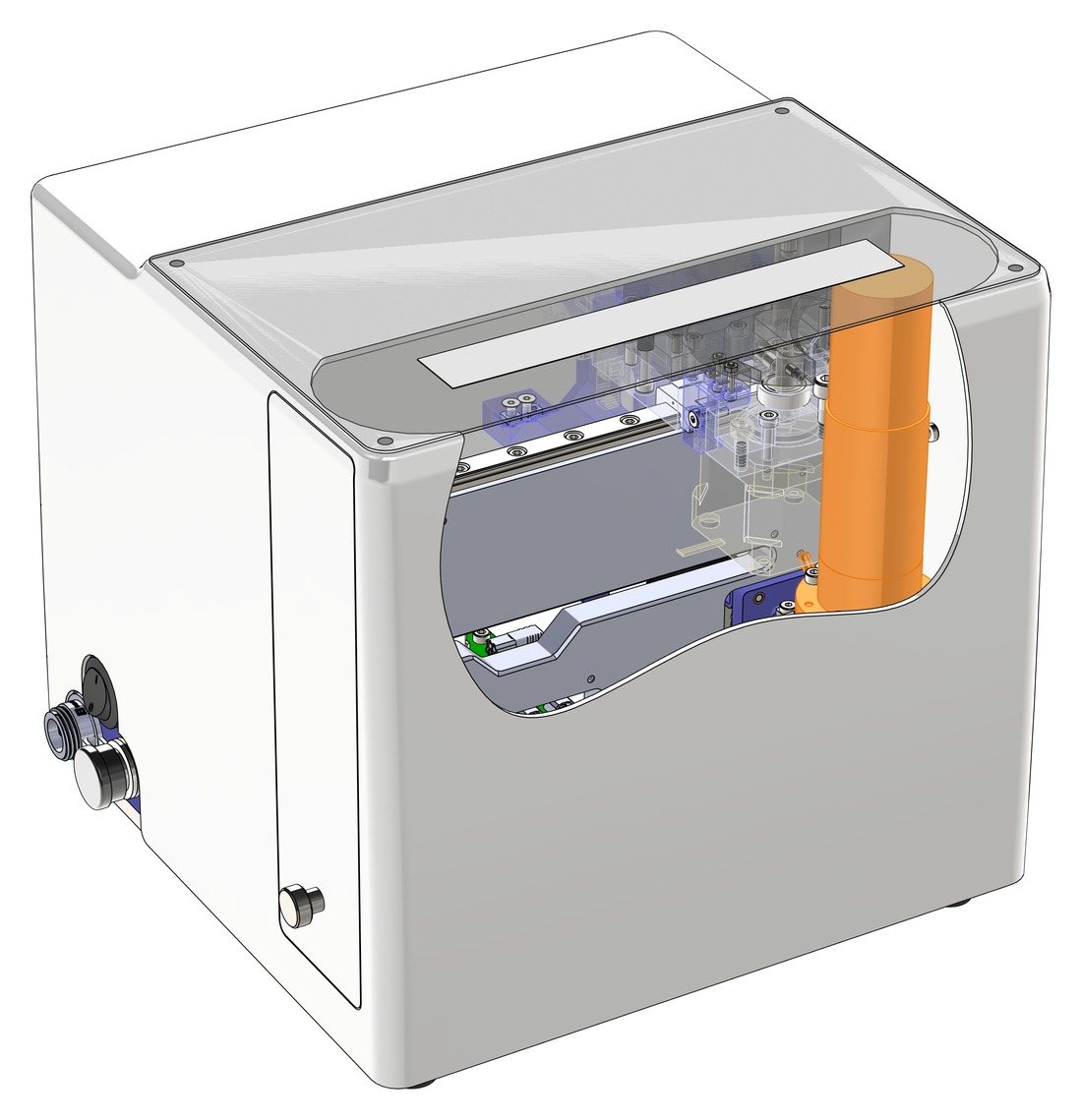
The heart of the TLC Wizard is a scintillation detector located in a tungsten collimator. The slot through which the detector is exposed to the measured activity is 2 × 20 mm with a variable depth of 6, 12 or 18 mm; changing the setting takes max. 20 s. This enables measurement of a wide range of activities and energies, from very low activities of 99mTc up to high activities of 68Ga.
The simply shaped body coated with durable 2K paint and the glass working surface provide excellent cleanability and allow wet strips to be measured, so there is no need to waste time drying chromatography strips. Daily QC can be performed automatically with the built-in check source in just two clicks.
Cover and colour versions
The cover of the device is made of carbon-fibre laminate and can be supplied in different colour versions – from pure white through any RAL colour to visible carbon. Every colour version has a white band carrying the Lynax logo, and the rating plate is on the rear side.
Colours shown are indicative.
Sample measurement report
Principle of operation
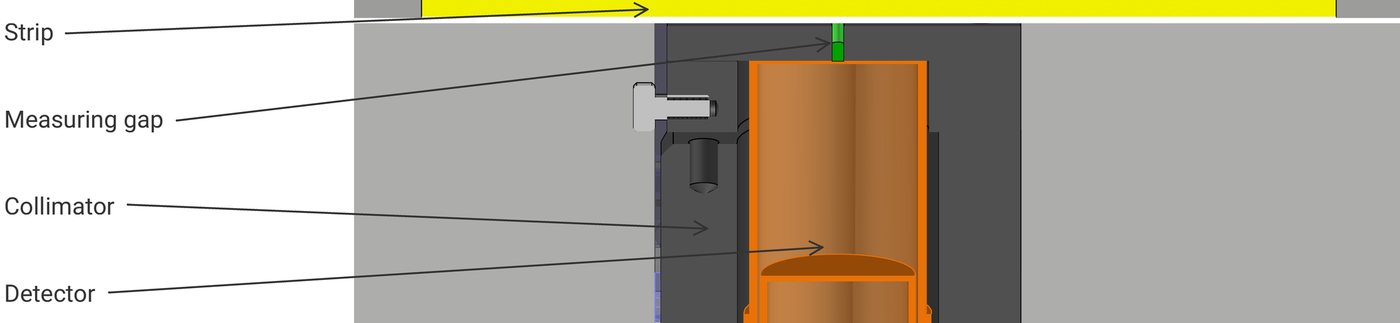
The detector is located inside a two-part tungsten collimator. In the basic setup, the primary collimator has a slot 2 × 20 mm wide and 6 mm deep. This restricts the radiation emitted by the activity on the strip to a narrow beam, resulting in high resolution (typically 2 mm) and sharp peaks. The collimation can be further adjusted by additional collimation inserts, which increase the collimated distance from the strip in two steps of 6 mm each.
The secondary collimator provides sufficient shielding of the detector to prevent background from affecting the measurement quality.
The collimator/detector assembly travels 0.5 mm below the glass top surface. With the glass itself being 1 mm thick, the total distance of the collimator from the measured strip is only 1.5 mm. This minimal distance further helps to reduce measurement inaccuracy caused by a larger distance and limited collimation in standard solutions.
Depending on the software settings, the measuring assembly moves in defined steps from the start to the end of the strip, measuring the activity at each position. Default setting: 4 mm steps, each measured for 5 s, so one measurement of a 150 mm strip takes just over 3 minutes. All settings can be customised.
Basic setup with 6 mm collimation:
Technical specifications
Dimensions
150 mm version, excluding computer and connectors
Power input
Measuring system
Scintillation detector, diameter 25 mm, height 25 mm, operated by a single-channel analyser
The height of the collimation opening can easily be changed to 12 or 18 mm for higher energies and activities.
Positioning electronics
- Modular Lynax electronics, 12 V, 5 A
- Main board: communication 115 200 Bd, 8 bit, start-up time 10 s, LED indication of device status
- Motor board: stepper motor driver with precise encoder, positioning linearity 0.05 mm, travel 150 mm (200 mm), variable speed 0.2–5 mm/s
Minimum computer specification
- Intel Core i5, 13" touchscreen, 2880 × 1920, 16 GB RAM, 256 GB SSD, 2× USB, Windows 11 Pro
- Printer: any A4 colour printer compatible with Windows 11
Specifications subject to change without notice.